
Self-employed or EURL: which legal status to choose for a craftsman in 2025?
Choosing between self-employed or EURL is not a minor formality: for a craftsman, this status affects your contributions, your cash flow, your relationship with VAT, your actual margin, and your ability to finance equipment.
In 2025, the right answer mainly depends on three very concrete parameters: the level of your expenses, your growth rate, and the degree of clarity expected by your clients, your bank, and your insurers.
Sommaire
In brief
⚡ Self-employed: perfect for starting quickly, testing an activity, and limiting administrative tasks.
🧮 EURL: better suited if your actual expenses, stock, or investments weigh on the margin.
🛡️ Since the reform of the sole proprietorship, the question is no longer just about asset protection.
🏦 For a craftsman who wants to borrow, recruit, or grow, the EURL often offers a clearer framework.
Self-employed or EURL: which status to prioritize?
For a craftsman starting alone with few expenses, the self-employed status often remains the simplest choice. If your purchases, subcontracting, vehicle, or equipment weigh heavily, the EURL becomes more coherent as soon as the net margin matters more than administrative simplicity.
The real question is therefore not “which status is best?”, but “which status best fits your way of working?”. A craftsman who mainly sells time and labor does not have the same needs as one who buys, transforms, stocks, and invests.
The right status is not the one that costs the least at the start, but the one that protects your margin when the activity grows.
Which differences really matter for a craftsman?
For a craftsman, the useful differences are not theoretical: they are seen in cash flow, VAT, deductible expenses, and clarity with the bank. The self-employed status simplifies everything; the EURL better structures an activity that buys, invests, and incurs regular expenses.
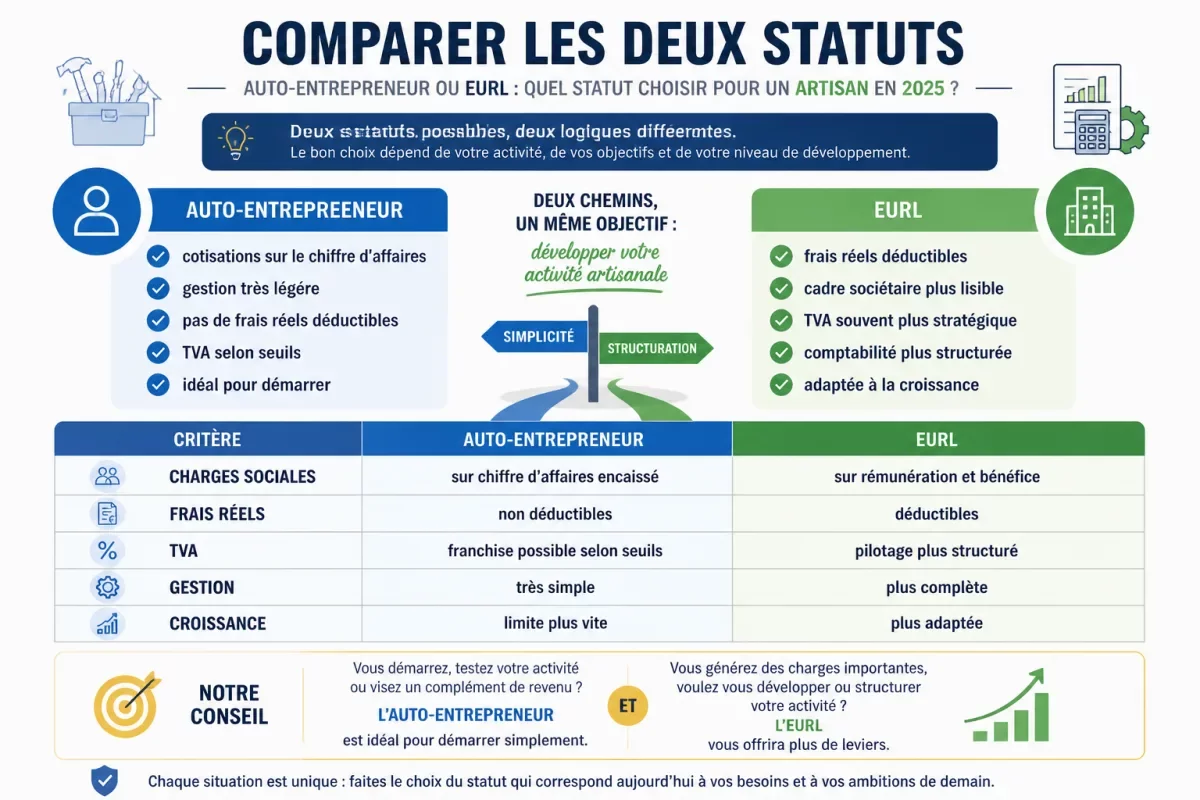
Social charges and cash flow
In self-employed, social contributions are calculated on the collected turnover. It is clear, predictable, and practical on a daily basis, but it becomes less comfortable as soon as your expenses increase. In EURL, the logic changes: you reason more in terms of profit and remuneration, which fits better with an equipped craft activity.
Actual expenses and VAT
The self-employed does not deduct actual expenses. If you buy many supplies, tools, raw materials, or external services, this limit eventually weighs down. In EURL, actual expenses can be taken into account, and managing VAT often becomes more strategic as the activity grows.
Liability and assets
The debate is often poorly summarized. Since the reform of the sole proprietorship, the self-employed already benefits from a more protective separation of assets than before. However, the EURL retains a more transparent corporate framework for third parties. Still be careful: a personal guarantee, mismanagement, or certain commitments can reintroduce risk.
Management and credibility
The self-employed status remains unbeatable for simplicity: few entries, little formality, quick start. The EURL requires more organization, but it often improves the perception of seriousness with a bank, insurer, or professional client who wants to see a stable and lasting structure.
As soon as your fixed expenses eat into your margin, the simplicity of the micro-enterprise can cost more than EURL accounting.
In which cases does the auto-entrepreneur status remain the best choice?
The auto-entrepreneur status remains relevant if you are starting alone, with few purchases, little stock, an activity still being tested, or high-margin services. It avoids heavy accounting and allows you to invoice quickly, provided you keep an eye on your actual expenses and the evolution of your activity.

This status often suits service artisans, light repair activities, occasional interventions, or professionals who want to test a market before investing. It is also useful when the primary goal is to remain mobile, responsive, and administratively light during the first months.
- You are starting out and you do not yet know if the order book will be regular.
- Your purchases are limited and your variable costs remain low.
- You mainly bill for time, not a large volume of materials or stock.
- You want to move quickly without multiplying accounting obligations.
When does the EURL become more interesting than an auto-entrepreneur status?
The EURL becomes more interesting as soon as your fixed costs increase, you need to recover VAT, finance equipment, or give a more structured image to your clients and partners. It requires more formality, but it fits better with a growing artisanal activity that invests.
It often takes the lead when the volume of professional expenses is high: vehicle, tools, insurance, raw materials, subcontracting, premises, or stock. At this stage, the benefit is not only fiscal; it is also financial, because you better manage your actual profitability.
- Your actual expenses are high and recurring.
- You purchase equipment or need to amortize investments.
- You seek better banking positioning to borrow or negotiate.
- You want to prepare for growth, or even a future partnership.
Which artisanal obligations change the calculation?
For an artisan, the legal choice cannot be separated from the rules of the trade: ten-year insurance, professional civil liability, qualifications, VAT management, and registration formalities. Two statuses may be suitable on paper, but only one will be viable according to your concrete obligations.
For certain building trades, the ten-year insurance is not a detail: it structures the budget, client relationship, and commercial credibility. The professional civil liability (RC pro) remains a useful foundation in almost all cases. The right status must absorb these costs without unbalancing your cash flow.
The artisanal nature of the activity also matters administratively. Declaration, qualification, possible training obligations, and VAT tracking must be anticipated before launch, especially if you sell services combining labor and supplies.
A key point for building trades
If your activity involves work that may engage your liability over several years, the EURL does not replace insurance, but it often helps better separate cash flow, investments, and the manager’s remuneration. For an artisan highly exposed to technical risk, this more structured framework is often more comfortable.
How to decide without making a mistake in 2025?
Decide based on your numbers, not on an instinctive preference. If your expenses are low and your market test short, the micro-entreprise often suffices. If you aim for investments, hiring, or rapid growth, the EURL quickly becomes more coherent.
The most effective approach is to compare three simple benchmarks: your level of expenses, your need for recoverable VAT, and your ambition for development. As soon as two of these three criteria shift towards complexity, the EURL deserves to be studied as a priority.
- Start with your expenses: if they remain low, the sole proprietorship retains the advantage.
- Look at your purchases: the higher they are, the more rational the EURL becomes.
- Project yourself 12 months ahead: if you need to invest or borrow, anticipate the corporate framework.
It is not the turnover alone that decides, it is the relationship between margin, expenses, and ambition.
Key takeaways
- ⚙️ The sole proprietorship is especially suitable when your expenses remain light and your start-up needs to stay simple.
- 🧾 The EURL becomes relevant when your purchases, stock, or equipment really impact the margin.
- 🛡️ Asset protection is no longer the only criterion: also consider VAT, banking, and clarity.
- 🏗️ For a building tradesman, insurance and professional obligations matter as much as the status.
- 📈 If you aim for growth, the EURL offers a more robust framework to structure the activity.