
In Brief
🧾 The real issue is not just the price of your insurance, but the declared capital: furniture, renovations, outbuildings, valuables. If this amount is too low, the compensation can shrink.
📸 The most reliable method remains the room-by-room inventory, with photos, invoices, and updates after each major purchase or renovation. A simple oversight on the garage or kitchen can be enough to create a noticeable gap.
⚖️ Do not confuse deductible and underinsurance: the deductible is a contractually agreed amount you pay, whereas underinsurance reduces the compensation because the insured capital is insufficient.
🔍 The right reflex: check your contract at least once a year and after moving, renovations, or purchasing expensive equipment. Cherry on top: a clean inventory also simplifies managing a claim.
How to Recognize Underinsurance in Home Insurance?
In practice, the problem often hides in a detail: you insure a home as it was three years ago, whereas in the meantime the furniture has changed, the kitchen has been redone, or the computer equipment has multiplied. Underinsurance is not visible at signing. It reveals itself when water, fire, or theft occurs.
You also need to distinguish several concepts that are often mistakenly mixed up. The furniture capital covers the belongings inside the home, the reconstruction value applies to the building, the new-for-old value replaces an item with a new equivalent, while the market value corresponds to its resale value. In other words, if these bases are poorly compared, you start off with the wrong benchmark.
A realistic estimate varies greatly depending on the household. In a family apartment of 60 to 80 m², the inventory of furniture and equipment quickly adds up, especially with appliances, computers, bedding, and small tools. An insured amount that is too low may therefore seem “reasonable” on the premium statement, while clearly being insufficient in real life.
It is observed on the ground that a real estate agent based in Nantes often sees the same scenario: after kitchen renovations or the purchase of a high-end television, clients keep the same insured capital “out of habit.” The contract hasn’t changed, but the standard of living has.
How to calculate the right capital without making a mistake?
The right method is nothing spectacular, but it avoids unpleasant surprises: you start from the actual home, not from a rough estimate. You need to list the furniture, appliances, IT equipment, clothing, bicycles, jewelry, audio devices, then fixed fittings like a fitted kitchen or a custom wardrobe. The goal is not to be perfect down to the last cent, but to be consistent and defensible in case of an audit.
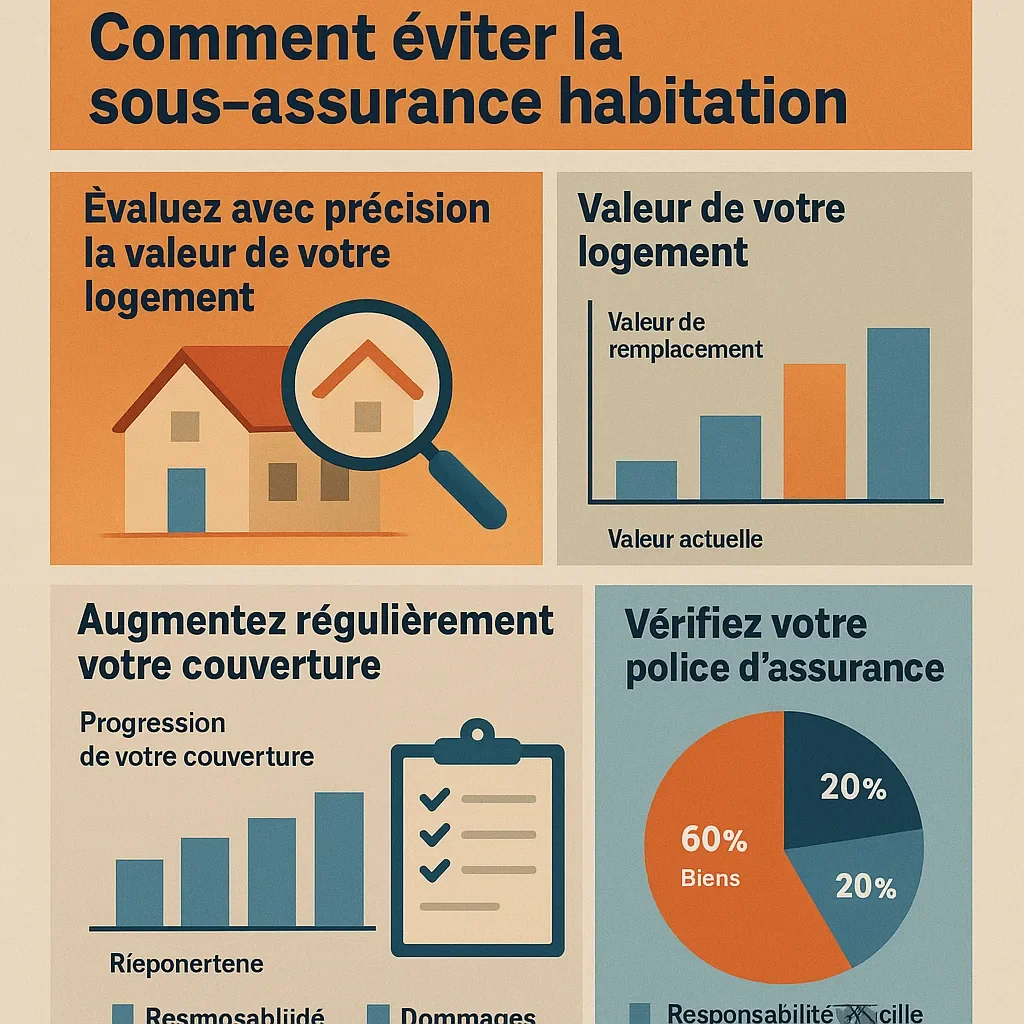
The simplest way is to proceed step by step, as if you were redoing the inventory of your house or apartment. Take one room, photographed from several angles, then note the important objects with their purchase date and condition. Yes, it’s a bit tedious. But it’s always less painful than manually disputing a claim after water damage.
| To declare | Why it matters | Good practice |
|---|---|---|
| Furniture and appliances | Replacement costs more than you think | Keep invoices and photos |
| IT and multimedia | Equipment accumulates quickly in a household | Update after each new purchase |
| Valuables | Jewelry, artworks, collections, photo equipment | Check specific limits |
| Work and fittings | Kitchen, bathroom, wardrobe, veranda | Notify the insurer as soon as the work is finished |
| Outbuildings and exterior | Garage, cellar, garden shed, tools, outdoor furniture | Do not leave them out of the contract |
A family who arrived in Bordeaux in 2023 recounts having discovered, after a simple change from an empty home to a furnished apartment, that the value of the contents to insure had almost doubled. Nothing extravagant though: a sofa, two computers, a washing machine, a few bikes, and the total climbs quickly.
Which goods and works must absolutely be declared?
The usual forgotten items are always the same, and they are costly: works, outbuildings, garden, cellar, garage, leisure equipment, jewelry, connected objects, and custom-installed equipment. In Paris or Lyon, where the replacement cost of a fitted kitchen or flooring installed by a craftsman can quickly rise, underestimation happens faster than one might think.
For works, you especially need to think about elements that change the reconstruction value or the repair cost: fitted kitchen, renovated bathroom, insulation, heat pump, joinery, terrace or fence. Even if you haven’t moved an inch, your home is no longer the same. And an insurer does not like contracts that remain frozen in the 2021 setting.
The right reflex is to treat goods in three groups: what is movable (furniture, electronics), what is fixed (fittings, works), and what is outside the main dwelling (cellar, garage, outbuilding, garden). This separation helps to check ceilings and exclusions without getting lost in the fine print.
- Common goods: sofas, bedding, tables, household appliances, TV, computers.
- Sensitive goods: jewelry, musical instruments, cameras, collections.
- Fixed elements: fitted kitchen, custom storage, flooring, bathroom.
- Annex spaces: garage, cellar, garden shed, swimming pool, terrace.
It should be noted that some companies set separate ceilings for valuable objects or outdoor equipment. If you exceed these amounts without noticing it, underinsurance hides in an exclusion or a sub-limit, which amounts to the same thing on the day of the claim: you think you are covered, but only partially.
What happens in the event of a claim if you are underinsured?
The most common unpleasant surprise is reduced compensation even though the contract has been properly paid for years. The insurer may request supporting documents, verify invoices, compare photos, and recalculate what should have been insured. The more unclear the file, the tenser the discussion. And when the house has suffered a fire or major water damage, no one wants to improvise.
The topic of the deductible also deserves to be separated from underinsurance. The Service-Public reminds that a deductible may remain the responsibility of the insured; in its example, a claim of €100 with a €150 deductible results in no compensation, whereas a claim of €200 would leave only €50 to be paid after the deductible. This is not the same mechanism as underinsurance, which reduces the reimbursement on the principal amount.
Good to know: if you dispute the evaluation, you must keep purchase receipts, before/after photos, quotes, and all written exchanges with the insurer. The more documented the file, the easier it is to demonstrate that a capital that was too low was not consistent with the actual condition of the property.
The classic mistake is not paying too little, but never updating your declaration after a purchase, renovations, or a move. That is where underinsurance sets in, not in the initial contract.
There may also be differences in treatment depending on the type of claim. A theft with a partial inventory, for example, is not handled like a total fire or electrical damage. On the ground, experts often check whether the contract was still aligned with the actual condition of the property at the exact time of the claim, which reinforces the importance of regular updates.
For repair costs, the INSEE regularly reminds that prices evolve over time, which sometimes makes an estimate made several years earlier obsolete. In other words, a correct capital in 2021 may become insufficient in 2024, even without extravagant purchases in the meantime.
Tenant, owner-occupier or landlord: who should monitor what?
The level of vigilance is not managed the same way depending on the profile. A tenant should mainly monitor the contents of the dwelling and personal belongings, while an owner-occupier must watch both the building, the furniture, and any improvements made. The landlord, meanwhile, focuses primarily on the structure, the equipment they provide, and the risks related to rented or vacant parts.
For a tenant, underinsurance often affects furniture, portable devices, and valuables. For an owner-occupier, it more often appears after renovations or a change of use: home office, finished basement, veranda, premium kitchen. As for the landlord, the real grey area is often the overlap between property insurance, tenant insurance, and respective responsibilities. In short, you need to read who covers what, otherwise you are walking blind.
- Tenant: contents, personal belongings, tenant liability.
- Owner-occupier: building, furniture, renovations, annexes.
- Landlord: structure, provided equipment, vacancy periods.
In a rented house with a garage, cellar, and small workshop, the most frequent oversight remains the undeclared annex. On the scale of a contract, this kind of detail seems tiny. But in the event of theft or fire, it is precisely these “extra” square meters that tip the balance.
What habits prevent unpleasant surprises?
The best habits are simple, almost mundane, and that’s precisely why we neglect them. You need to photograph important belongings, keep receipts, note purchase dates, review coverage limits after a major purchase, and notify the insurer as soon as any work changes the value of the home. Insurance is not a fixed object; it must follow your real life, not the other way around.
The most effective approach is often to create a single folder, on your phone or in the cloud, with three tabs: photos, receipts, work. This organization takes little time initially, but it becomes invaluable if an expert asks you for proof of an appliance, a piece of furniture, or a renovation. And honestly, the minute spent beforehand is worth its weight in gold.
- Once a year: reread the coverage limits and exclusions.
- After a major purchase: update the personal property coverage.
- After work is done: report the increase in the home’s value.
- After moving: redo the complete inventory.
- After a birth or departure: adjust the insured contents.
It is always advisable to also check the proof requirements: some contracts require receipts for valuable items, others accept dated photos or estimates. That’s why a well-read contract is better than one merely signed. The difference often lies in those fine print lines that no one opens on a Sunday afternoon.
FAQ — Home Underinsurance
How can I tell if I am already underinsured without calling in an expert?
Start by comparing the insured amount with the actual inventory of furniture, work, and outbuildings. If you have renovated, bought computer equipment, or added outbuildings, there is a good chance the declared amount has become insufficient. An annual check is often enough to spot the gap.
Are valuable items automatically covered by the contract?
Not necessarily. Jewelry, artworks, collections, musical instruments, or cameras are often subject to specific limits. Beyond a certain amount, a separate declaration or an extended guarantee may be required. It’s better to check the sub-limits before a theft brings the fine print to light.
Does home underinsurance also concern a tenant?
Yes, but mainly for the contents of the home. A tenant can be underinsured if they underdeclare their furniture, computer equipment, or valuables. Liability related to the rented home may be covered differently, but personal contents remain a sensitive point.
What is the difference between underinsurance and deductible?
The deductible is the portion provided for in the contract that remains your responsibility after a claim. Underinsurance, on the other hand, reduces compensation because the declared amount is too low compared to reality. You can have both at the same time, which clearly doesn’t help your wallet.
Can I contest a compensation deemed too low?
Yes, if you have solid proof: receipts, photos, quotes, dated inventory, written exchanges with the insurer. In case of disagreement, you can request a counter-expertise or a review of the file. The cleaner your documentation, the more weight your contestation carries.
Should I reassess my insurance after a simple purchase or only after major work?
Both matter. A single purchase may seem trivial, but several small additions eventually create a real discrepancy. Major work is more visible, but computers, appliances, and leisure items also increase the value to be insured, sometimes faster than you think.