
In brief
😎 The bank contract is simple to subscribe to, but it often remains more standardized. It matches the loan, not necessarily your profile.
🔎 The external insurer can cost less, especially if you are young, a non-smoker, and have a standard health record. The benefit quickly rises on a long loan.
⚖️ The real arbiter is not the displayed monthly premium, but the trio TAEA, guarantees, and exclusions. The rest is just commercial decoration.
📌 Since the Lemoine law, it is easier to change insurance mid-term. In other words, the contract signed at the start is no longer a life sentence.
Bank or external insurer: what concrete difference?
The bank’s group contract is simple, standardized, and often integrated into the loan file. The external insurer works by delegation: it can be cheaper and more tailored to the profile, provided the equivalence of guarantees is respected. The right choice therefore depends on the total cost, not just the displayed rate.
The basic operation is very simple. The bank often offers its group contract, shared among several clients, with fairly broad criteria and a premium that varies less on a case-by-case basis. The external insurer, on the other hand, sells an individual contract: age, profession, lifestyle habits, health status, or sports practice weigh more in the price and guarantees.
In practice, the bank bets on smoothness: a single process, a signature often synchronized with the loan, and few questions on the client side. The external one requires a little effort in comparison, but it often allows for finer coverage. This is where the borrower insurance comparison becomes useful: if you only look at the monthly premium, you risk missing a better calibrated contract, or conversely signing a formula that is too light.
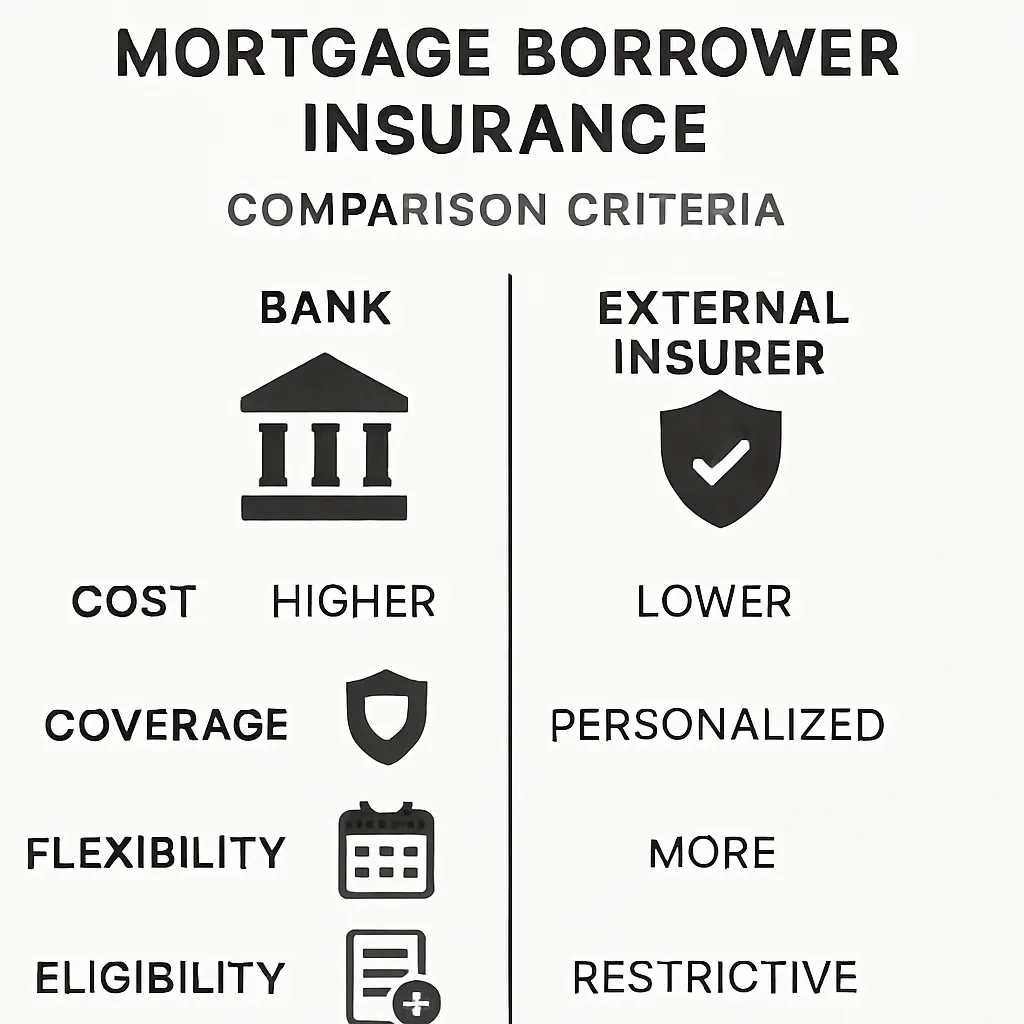
| Criterion | Bank insurance | External insurer |
|---|---|---|
| Pricing | Mutualized, often clearer | More individualized according to the profile |
| Flexibility | Less adjustable | Often more adjustable contract |
| Price | Not always the lowest | Often advantageous for low-risk profiles |
| Guarantee / exclusions | Standard framework, sometimes broader on certain files | Essential to read exclusions and deductibles |
| Process | Very simple with the loan | Requires a real comparison |
Joking aside, there is no automatic winner. A bank contract can remain relevant if the file is complex or if simplicity is worth more than hunting for pennies. Conversely, an external insurer often becomes formidable as soon as the profile is healthy and the loan stretches over twenty years or more.
How to make a borrower insurance comparison without making mistakes?
The right borrower insurance comparison is done on the TAEA, included guarantees, exclusions, waiting and elimination periods, the coverage percentage, and the age limit. A low price can hide less protective coverage or surcharges. You must compare equivalent risks, not just premiums.
The classic trap is to look at the premium first and everything else second. Bad idea. The right reflex is to compare the total cost and especially what happens in case of a hard blow: death, permanent disability, temporary work incapacity, job loss if the option exists. In other words, coverage must be put back at the center of the discussion.
Here are the criteria that really matter in a borrower insurance comparison:
- TAEA: this is the annual effective insurance rate, the most telling figure to compare two offers.
- Coverage percentage: it indicates the portion of the loan covered for each borrower, for example 50/50, 70/30, or 100/100.
- Exclusions: back, psychological, risky sports, pre-existing conditions… the devil is often hidden there.
- Deductible and waiting period: the longer they are, the longer you wait before being compensated.
- Age limit: some contracts become less attractive as you get older.
- Health and surcharge: a medical questionnaire can increase the price or block certain guarantees.
It should be noted that the standardized information sheet provided by the bank is precisely intended to put the offers on the same starting line. Without it, comparing is a bit like jogging with weights on your ankles: you think you are moving forward, but you are not running under the same conditions. This is also why the Ministry of Economy details the framework of borrower insurance and why the ANIL recalls the rules of insurance delegation.
Which profiles benefit from leaving the bank’s contract?
Insurance delegation often becomes more interesting for young, stable profiles with low medical risk exposure. Conversely, an older borrower, smoker, or one involved in a risky profession must look very closely at the contract, because the price difference can be huge… or sometimes significantly reduced depending on the medical questionnaire.
In Lyon or Nantes, you often see first-time buyer couples who benefit from closely examining external insurance, because they combine a still favorable age and a long loan duration. In Toulouse or Rennes, rental investment files can also benefit from more flexible delegation, especially when the borrower wants to optimize the overall financing cost without compromising on the main protection.
On the ground, a credit broker based in Nantes observes that many couples save on the premium but forget the logic of coverage percentage. Result: the insurance seems cheaper, yet the household’s protection remains shaky if the distribution does not match the actual incomes.
In other words, external insurance is not “the right choice” by principle. It becomes especially relevant when the profile remains easy to insure, the guarantees required by the bank are well respected, and the comparison is not limited to the face price. For a file with fragile health, one sometimes has to balance between surcharge, exclusions, and coverage level. Again, the smartest contract is not necessarily the flashiest.
How much can you save with insurance delegation?
On a long loan, the savings can be very significant. Depending on the amount borrowed, age, and health, switching to an external insurer can represent several thousand euros in savings, and sometimes much more. The real lever is the duration: the longer the loan lasts, the more the price difference accumulates.
The best borrower insurance is not the cheapest on paper: it is the one that costs less for comparable coverage. Without this filter, the comparison quickly goes off track.
On a loan of €200,000 over 20 years, a modest price difference at the start can end up weighing heavily overall. If the external premium is lower by a few dozen euros per month, the total bill can quickly tip. And on a higher financing, for example €250,000 or more, the difference becomes even more noticeable.
The most important thing is not to look for “the cheapest,” but “the best price/coverage ratio.” An external insurance can beat the bank on price, then lose all its interest if it excludes a pathology, caps an ITT guarantee too low, or imposes a poorly calibrated deductible. Conversely, a more expensive group contract can remain coherent if the profile presents a health or occupational risk difficult to insure elsewhere.
How to change borrower insurance without blocking the loan?
Changing is now much more flexible than before. The logic is simple: you find a new insurance, you verify the equivalence of guarantees, then you request the substitution from the bank. The bank cannot refuse just for the sake of it; it must justify its refusal if the guarantees do not match. And, since the Lemoine law, cancellation can occur at any time on ongoing contracts.
The key point is to anticipate the documents. The standardized information sheet allows you to compare the required guarantees, line by line. In practice, the bank mainly checks if the new contract covers at least the same level of risk on the mandatory guarantees. If everything is good, the substitution should be smooth. If the file gets stuck, it is often because an exclusion, a deductible, or a disability definition does not correspond to what the lender requires.
- Request the bank’s requirement sheet and obtain the details of the expected guarantees.
- Compare several offers, keeping the same level of coverage for the share and guarantees.
- Send the substitution request with the new contract to the bank.
- Wait for the written response: the processing time is usually 10 working days.
- If the bank refuses, it must explain precisely what is wrong.
For basic rules and points of caution, the reference pages of the Ministry of Economy and the ANIL remain the most useful: they recall the legal framework, the logic of delegation, and the interest of a contract compatible with the lender’s requirements. Good to know: since 2022, the change window is no longer locked as before, which gives borrowers a bit more breathing room.
FAQ
Can a bank refuse my external insurer?
Yes, but only if the equivalence of guarantees is not respected. The refusal must not be vague: the bank must specify the blocking point, for example a different disability definition or a missing guarantee. Without a clear reason, contesting becomes easier.
Is it mandatory to insure each borrower at 100%?
No. The share can be distributed differently, for example 50/50, 70/30, or 80/20. However, on a purchase by two people, the coverage must match the income and the real risk of the household. A share too low on one of the two can save a lot… but result in somewhat shaky protection.
Should a rental loan be insured like a primary residence?
Not necessarily at the same level of protection, but the bank can still require serious coverage. For a rental investment, more flexible trade-offs are often seen on certain additional guarantees. However, the death guarantee generally remains essential, as it secures the repayment of the principal.
Has the medical questionnaire disappeared for everyone?
No. It has been removed in certain specific cases: €200,000 maximum per insured and repayment of the loan before age 60. Beyond that, a questionnaire can still be requested. This is one of the major advantages of the Lemoine law, but not a universal blank check.
When to compare to get the best price?
As early as possible, ideally before the final signing of the loan. But if the contract is already in place, it is still worthwhile to compare, as cancellation is now more flexible. For long-term loans, even a small difference in monthly rates can represent a real overall gain.
Does a smoker necessarily have an interest in staying with the bank?
Not necessarily. It all depends on the pricing policy of the external insurer and exclusions. Some bank contracts are more straightforward, but other alternatives remain competitive despite smoking. The important thing is to compare the real cost, not to rely on a general intuition.