
In brief
🧾 The car insurance bonus-malus is based on a reduction-increase coefficient that follows the insured driver, not just the vehicle.
📉 Without a responsible claim, the coefficient generally decreases by 5% per year. With a responsible accident, it can jump by 25% at once.
🚗 In the long term, the system rewards consistency: the maximum bonus of 0.50 is built over time, often after several years of clean driving.
📌 To improve it, the golden rule remains simple: avoid responsible claims, report with discernment, and verify that your history has been properly transferred when changing insurers.
How does the car insurance bonus-malus work?
The car insurance bonus-malus is a coefficient applied to the reference premium. It starts at 1.00, decreases by 5% per year without a responsible claim, and increases in case of an accident attributable to the insured. The calculation follows the contract and the driver’s history.
According to Service-Public.fr (sheet on the reduction-increase, regularly updated), the principle is governed by the Insurance Code on Légifrance. In other words, your insurer does not reinvent the rule at each renewal: it applies a legal scale.
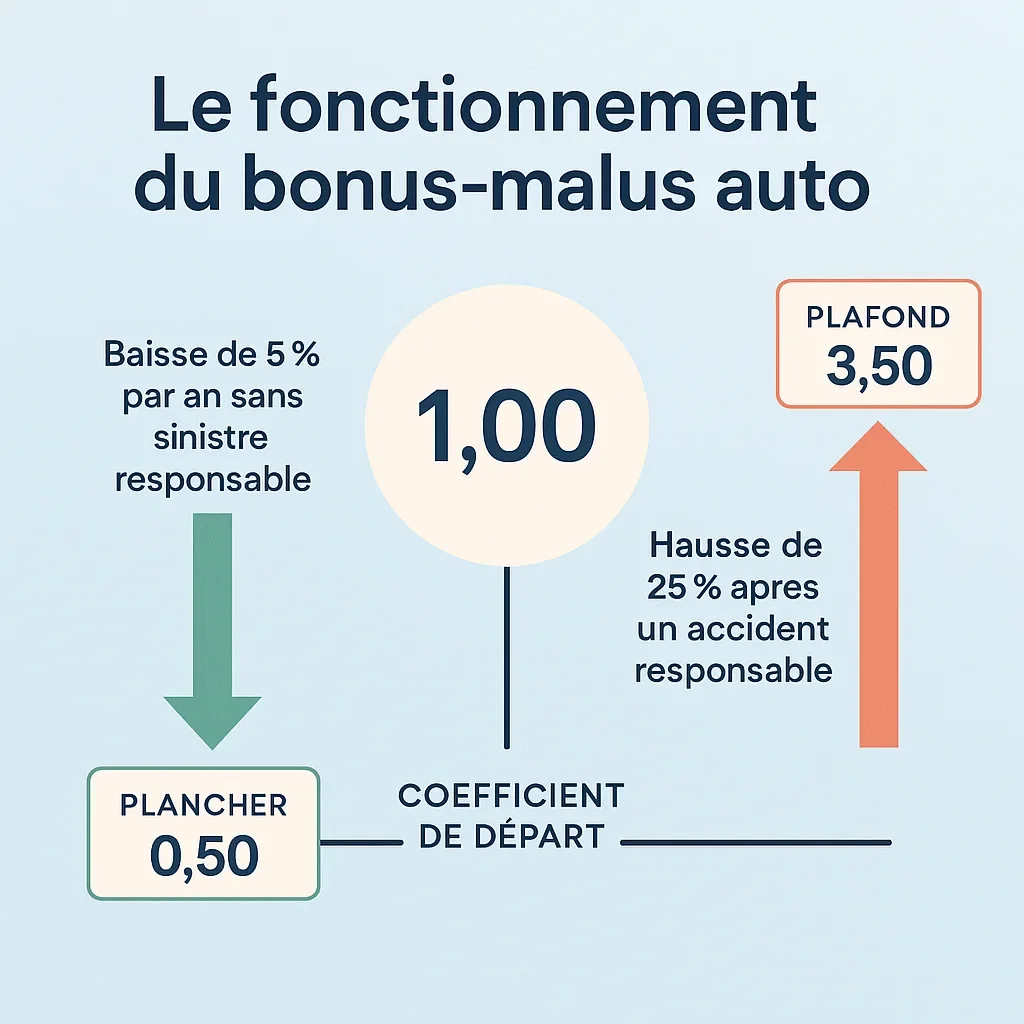
Practically, the insurer multiplies the base premium by your coefficient. If your contract shows an annual premium of €600 and a coefficient of 0.80, you pay €480. If the coefficient rises to 1.25 after a responsible accident, the same base climbs to €750. This mechanism may seem cold, but it is extremely transparent.
The most important thing to remember is that the car insurance bonus-malus does not depend solely on the car model. It depends first on your driving behavior, then on the history transferred from one contract to another. In other words, the system follows the driver’s trajectory over time, which explains why a “clean” record eventually carries significant positive weight.
Why does an accident increase the premium?
A responsible accident triggers an increase in the coefficient, often by 25%. The insurer considers that the annual risk has increased, so has the premium. Non-responsible claims, on the other hand, generally do not trigger a penalty on the auto bonus-malus.
The insurer’s reasoning is quite simple: the higher the statistical risk, the higher the pricing. A responsible accident is therefore not just a one-time event. It changes the perception of risk for the following year, and sometimes beyond if other claims are added. This is where the system becomes a real pricing lever.
It is also important to distinguish between claims that affect the auto bonus-malus and those that do not. A glass breakage, a theft, or damage related to bad weather generally do not follow the same logic as an accident where the driver’s responsibility is engaged. This nuance avoids many misconceptions and some unnecessary cold sweats.
| Situation | Effect on the coefficient | Key takeaway |
|---|---|---|
| Year without responsible claim | Reduction of 5% | The bonus progresses slowly but surely. |
| Fully responsible accident | Increase of 25% | The increase can be noticeable from the next renewal. |
| Glass breakage, theft, bad weather | Generally no penalty | It all depends on the activated coverage, not the bonus-malus. |
| Clean history over several years | Coefficient decreases | Consistency eventually pays off. |
In practice, a responsible accident is not “serious” in the same way depending on the vehicle’s use. In Lyon, a driver who drives little during the week but a lot on weekends will not experience the same impact as a salesperson who drives 30,000 km per year. The coefficient remains the same in its logic, but the increase affects very different budgets.
How to improve your auto bonus-malus?
To improve your auto bonus-malus, you mainly need time and driving without responsible claims. The best levers are simple: avoid unnecessary declarations, limit minor collisions, and check that the coefficient has been correctly applied when changing contracts or insurers.
The most effective method is nothing magical: drive carefully, year after year. The auto bonus-malus decreases gradually when no responsible claim is declared. This may seem slow, but it is precisely what makes the system predictable. The cleaner your history, the closer the premium gets to the favorable floor.
It is also useful to think before declaring minor damage. A parking scratch, a slightly rubbed bumper, or a small dent can sometimes cost less to fix yourself than to report on the contract. This is not an absolute rule, of course, but in practice, many drivers discover that a “small” claim can end up as a big bill over two or three years.
It is observed in practice that a driver who pays for a modest repair themselves sometimes avoids a premium increase much heavier than the initial cost. An agent often notes that claims declared “as a matter of principle” end up weighing more than the damage itself. This is a classic, and not only in the Paris region.
Another useful reflex: keep an eye on the insurance certificate and the history provided by the previous insurer. When a file moves from one company to another, a transfer error can happen, especially after a vehicle change or a suspension period. In Marseille as in Lille, the problem remains the same: a misreported coefficient is easier to correct immediately than six months later.
Finally, compare the overall premium, not just the coefficient. Two contracts with the same auto bonus-malus can cost very differently depending on the deductible, coverage, or parking area. In short, improving your coefficient is the foundation, but optimizing your insurance also requires looking at the contract as a whole.
Reflexes that prevent degrading the coefficient
The auto bonus-malus rarely worsens because of a major spectacular event. Most often, it’s the small habits that make the difference: poor safety distance, risky parking, too quick a declaration of minor damage. The goal is not to drive tensely, but to reduce the chances of a responsible claim.
On paper, it boils down to a few simple principles. In real life, it’s not that complicated, but you have to be consistent. And that’s exactly where many get trapped: they improve their driving for a few months, then relax their attention just when the coefficient finally starts to decrease.
- Avoid risky maneuvers in parking lots and narrow streets.
- Limit pressured trips when fatigue or stress increase the risk of error.
- Check coverage before declaring a small claim that would only weigh down the file.
- Compare deductibles: a deductible that is too low can be costly in the long run.
- Check the transfer history when changing car or insurer.
The bonus-malus does not reward perfection, it rewards consistency. Those who improve it fastest do not try to avoid every scratch of the real world; they mainly avoid turning a small incident into a costly claim.
Auto bonus-malus: special cases and misconceptions
The auto bonus-malus generally follows the insured driver, not just the vehicle. So, when you change cars, the coefficient does not reset to zero magically. It is taken up by the new insurer based on the history provided. This is good when you have a good record, much less so if you carry some maluses.
Another common misconception: “if I lend my car, the malus does not concern me.” False, or at least too simplistic. It all depends on the circumstances, the contract, and the responsibility in the claim. A poorly framed lending of the wheel can create surprises, especially if the occasional driver is not declared as required.
You also have to distinguish the auto bonus-malus from other pricing elements, such as parking location, driver’s age, vehicle power, or professional use. A driver based in Bordeaux with a good coefficient may pay more than a more penalized motorist driving in a less exposed context. That’s why the coefficient is important, but never isolated from the rest.
Does the bonus-malus change when switching insurance?
Yes, but not in the way sometimes imagined. The coefficient follows you because it is linked to your driver history. If you switch from one insurer to another, the new contract generally takes over the situation transmitted by the old file. Changing insurer therefore neither makes a malus disappear nor creates an extra bonus magically.
However, changing insurance can affect the final price at the same coefficient. Coverages, deductibles, exclusions, and additional services are not all identical. This detail matters a lot, especially if your bonus is already good: at equal coefficient, commercial differences can remain significant.
FAQ
Does a broken window increase the auto bonus-malus?
Generally, no. A broken window is usually covered by a specific guarantee and does not cause a malus like a responsible accident. That said, you should always reread the contract, as coverage conditions can vary from one insurer to another.
Can you keep your bonus when changing cars?
Yes, the coefficient normally follows the driver and their history. When you replace a vehicle, the insurer takes over the previous situation instead of starting again at 1.00. That is precisely why a good bonus is a real little capital.
Does the bonus-malus apply to young drivers?
Yes, and often with a more visible impact, because the starting premium is already higher. The system does not “penalize” young age itself; it mainly reacts to the driving history. Over time and without at-fault claims, the coefficient decreases just like for other profiles.
Can you improve your coefficient faster by paying more?
No, the coefficient cannot be bought. The only sustainable way to improve it is to drive without at-fault claims and let time do its work. However, you can sometimes optimize the total cost of the contract by adjusting the coverage and deductible.
What to do if the insurer made a mistake in my auto bonus-malus?
You need to request a verification of the transmitted history and keep the documents of your previous contracts. The insurance certificate and information statements serve as a basis for verification. The sooner you react, the easier it is to obtain a correction.
Does a secondary driver benefit from the bonus?
Not automatically. The bonus-malus is primarily linked to the main driver declared on the contract. If the secondary driver later becomes the main insured on another contract, their own history may be taken into account according to the rules for taking over prior history.