
In brief
👓 The key point of optical mutual insurance reimbursement is the difference between flat-rate in euros and percentage of base. In optics, the percentage alone often leaves a higher out-of-pocket cost than you might think.
💡 The 100% Health can bring the bill down to zero euros on eligible equipment, provided you have a responsible contract and accept a stricter choice framework.
📄 A valid prescription, a detailed quote, and careful reading of the caps on frames and lenses are often enough to avoid a bad surprise at the optician’s.
🧠 For progressive lenses, contact lenses, or equipping an entire family, the best mutual insurance is not the most expensive: it is the one that fits your actual usage.
How is the optical mutual insurance reimbursement calculated?
In optics, Social Security sets a very low base, which means that the percentage shown in a coverage table does not tell the whole story. The key word to watch is the reimbursement unit: % of BR, annual flat-rate, or reimbursement per equipment. In other words, a 400% contract does not necessarily mean much if the base is tiny.
The clearest, in practice, often remains the optical flat-rate. It clearly tells you how many euros are reimbursed for the frame, for the lenses, or for the whole set. This is particularly useful when you compare two quotes with lenses of different types, because the real extra cost jumps out much faster than a well-dressed percentage.
According to the Ameli fact sheet on glasses and contact lenses, the coverage rules also depend on the validity of the prescription. For eyeglasses, age matters: under 16 years old, the prescription is valid for 1 year; from 16 to 42 years old, 5 years; after 42 years old, 3 years. This is not a detail; it often conditions the renewal.
- % of base: useful for certain items, but often not very effective in optics.
- Flat-rate in euros: more concrete, especially for glasses outside the basket.
- Annual cap: practical if you renew often or if several household members are equipped.
How to read your contract to avoid a high out-of-pocket expense?
The coverage table deserves a little decoding, otherwise it becomes a nice stage decoration. First, spot the words flat rate, ceiling, reimbursement base, third-party payment, and waiting period. Then, see if the mutual insurance distinguishes the frame from the lenses, because the reimbursement gap can be huge between the two.
A good contract does not just announce a large overall coverage. It also details the level of coverage according to the type of lenses: single vision, unifocal, progressive, with thinning or specific treatments. Joking aside, this is often where the budget soars, not on the frame itself.
In optics, the real good deal is not the lowest premium, but the contract that fits your actual usage. Otherwise, you save almost nothing every month and regret it at the time of the quote.
Here are the questions to ask before signing:
- Is the reimbursement expressed in euros or in percentage?
- Does the frame have a separate ceiling?
- Do progressive lenses have an enhanced reimbursement line?
- Are contact lenses included in a separate flat rate?
- Is there a waiting period upon joining?
100% Health or equipment outside the basket: what should be compared?
The 100% Health basket is the simplest solution when you want zero out-of-pocket expense on eligible equipment. But as soon as you go outside the basket, you gain freedom in choosing the frame, lenses, and options. So the question is not just the displayed price: it is the level of freedom you pay for.
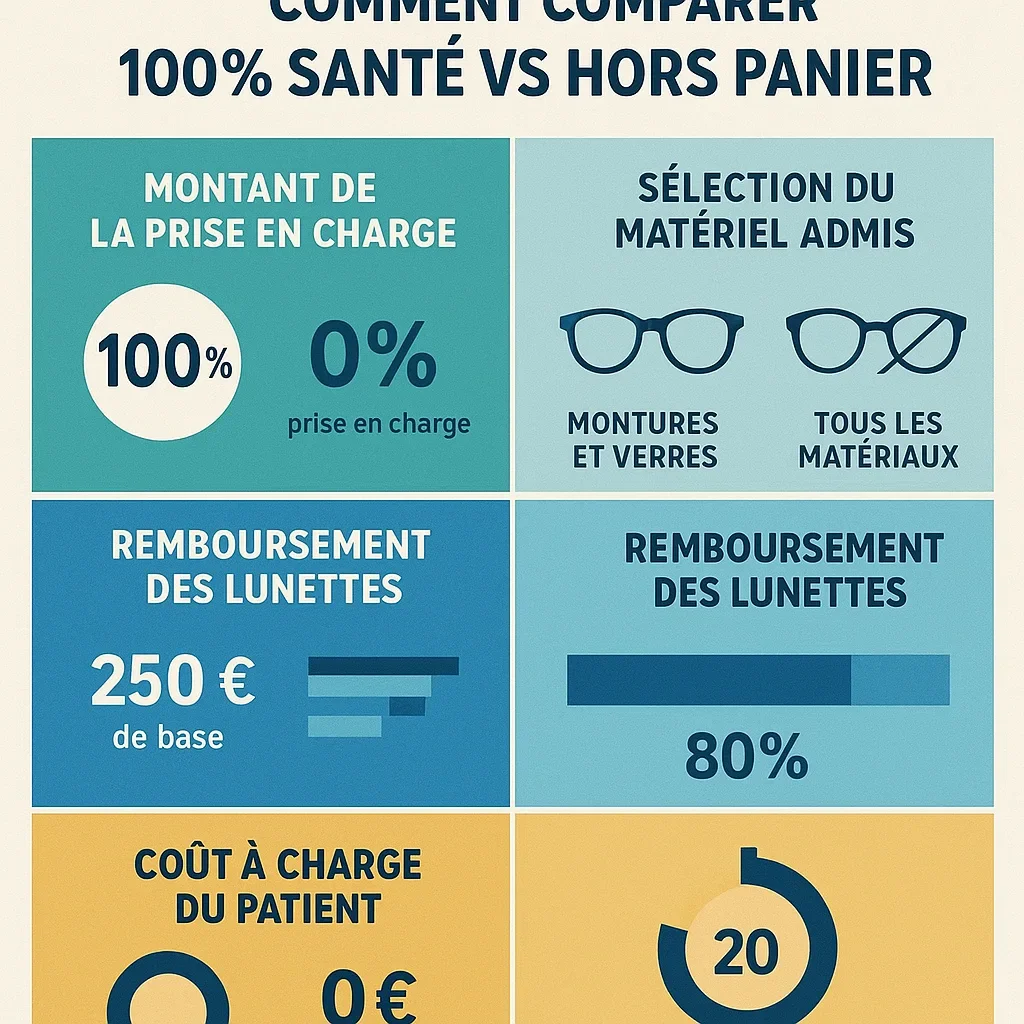
In practice, the good comparison is to request two quotes: one within the 100% Health basket, one outside the basket. You immediately see if the difference in visual comfort justifies the extra cost. This is especially true for progressive lenses or technical options, where the bill can rise faster than a shopping basket at the end of the week.
| Option | What you get | Impact on budget | When it is relevant |
|---|---|---|---|
| 100% Health | Eligible equipment, price framework controlled | Zero out-of-pocket expense on the eligible part | Tight budget, standard need |
| Outside basket with flat rate | More choice on frame and lenses | The flat rate absorbs part of the price | If you want better comfort or more style |
| Outside basket with % of BR | Coverage sometimes readable on paper | Can remain low in optics | If the contract is already very solid on lenses |
| CSS | Access to the basket without extra cost on eligible items | Very low, even zero | If you are eligible for the Complementary Health Solidarity |
The system has been regulated by public authorities since 2020, and it plays a central role for households wanting to avoid a painful bill. For eligible people, the Service-Public fact sheet on Complementary Health Solidarity remains a good starting point.
What level of coverage should you choose based on your profile?
The right level of coverage mainly depends on your prescription and your renewal frequency. A person with simple glasses does not have the same needs as someone wearing progressive lenses, nor as a family equipping two children and an adult in the same year. The idea is to buy targeted protection, not a complicated system.
To keep it simple, think in terms of profiles:
- Adult with single vision lenses: a moderate plan may suffice if you sometimes use the 100% Health option.
- Wearing progressive lenses: it’s better to have enhanced coverage on the lenses, as the technical cost rises quickly.
- Child or teenager: the renewal frequency matters more, as needs change faster.
- Regular contact lens wearer: look for a separate and clear ceiling, otherwise the plan can be exhausted very quickly.
In practice, a receptionist at a health center notes that families almost never choose the same coverage for all household members. The child often goes with the 100% Health option, while the parent keeps a more robust plan for progressive lenses. Result: a fairer contribution and fewer unpleasant surprises on the quote.
Another simple lever is to compare the contract based on a concrete need, not a marketing slogan. If you change your glasses every 2 or 3 years, a very high ceiling is not necessarily useful. Conversely, if you wear complex lenses, the logic reverses and you need to strengthen the optical coverage.
Glasses, contact lenses, or refractive surgery: what is really reimbursed?
Reimbursement does not work the same way depending on the type of equipment. Glasses remain the most common item, contact lenses are more regulated, and refractive surgery mainly depends on high-end contracts. In other words, not everything falls into the same category, and this is where people most often make mistakes.
For contact lenses, the mutual insurance may offer an annual allowance, but coverage is not automatic. In practice, a medical prescription and a recognized indication are required. Reimbursement therefore does not follow the same logic as for glasses, where the 100% Health basket greatly simplifies the calculation.
For refractive surgery, the situation is different again. Some supplementary insurances reimburse a flat rate per eye or per operation, but this is neither systematic nor very generous in entry-level contracts. If this option interests you, check the exclusions, the annual ceiling, and especially the waiting period.
If you have a tight budget, the best reflex is still to first check your eligibility for the Complementary Health Solidarity and the 100% Health basket. Optical mutual reimbursement then takes on a whole new dimension, because the final bill can really drop to a very low level.
What mistakes cause the out-of-pocket costs to rise?
The out-of-pocket costs mainly increase when the estimate is poorly compared, options are forgotten, and a too vague warranty is chosen. An optical contract should be read like an instruction manual, not as a marketing line: it is the actual ceilings that count, not the big words.
- Choosing a contract based on price alone: a low contribution can hide a tiny ceiling.
- Forgetting to ask for two estimates: 100% Health basket and non-basket do not tell the same story.
- Confusing % of BR and flat rate: in optics, it is not the same level of protection at all.
- Ignoring lens options: thinning, anti-reflective, or progressive lenses can make the total explode.
- Not checking the renewal: an estimate made at the wrong time can block coverage.
The best way to avoid mistakes is to start from the optician’s estimate, then go back to your mutual insurance, not the other way around. You compare the actual price, look at what Social Security covers, then check what your complementary insurance adds. This method is a bit less glamorous than a slogan, but much more effective.
And if you hesitate between two contracts, keep a simple rule: the one that reimburses your usual equipment better is generally more interesting than the one that shows the highest percentage. In optics, precision almost always beats marketing hands down.
FAQ
Can you get good optical mutual reimbursement with a small contribution?
Yes, but only if your needs are modest or if you often use 100% Health. A low contribution quickly becomes limiting as soon as you move to progressive lenses or technical options. The secret is the match between the guarantee and actual use.
Are options like blue light protection reimbursed?
Sometimes yes, but rarely as a separate item. They are often included in the price of the lens, thus reimbursed indirectly according to the contract formula. If the option increases the estimate, always ask for details when comparing offers.
Is a mutual insurance with a high percentage necessarily better than a flat rate?
Not at all. In optics, a high percentage on a very low reimbursement base can give a disappointing result. A flat rate in euros is often clearer, especially for glasses outside the basket or complex lenses.
Are contact lenses reimbursed every year?
Most often, the complementary insurance provides an annual or date-to-date flat rate, but the detail depends on the contract and medical indication. For regular wearers, it is especially important to check the overall ceiling, otherwise the flat rate can be used up very quickly.
Does the Complementary Health Solidarity (CSS) cover optics well?
Yes, on eligible equipment under 100% Health, CSS clearly changes the game. For low-income households, it is often the best entry point to limit out-of-pocket costs. The easiest is to check eligibility on Service-Public.
When should you change optical mutual insurance?
The ideal is to do it at the time of contract renewal, or when your need changes significantly: first pair of progressives, child who often breaks their glasses, or switching to contact lenses. That is when the difference between two guarantees becomes really visible.