
In brief
🧓 Hospitalization = the basic coverage not to be overlooked: daily allowance, private room, excess fees, and home help can quickly drive up the bill.
👓 Optical, dental, audiology = the three areas where out-of-pocket costs rise quickly, especially if you go beyond the 100% Health basket.
💶 A good senior health insurance is first read through the ceilings, waiting periods, and exclusions, not just the monthly premium prominently displayed.
What coverage is really essential in a senior health insurance plan?
The core of the contract is hospitalization. When a stay drags on, it’s not just the bed that’s expensive, but also the daily allowance, private room, fees above the base rate, and sometimes comfort charges. If this part is shaky, everything else becomes secondary.
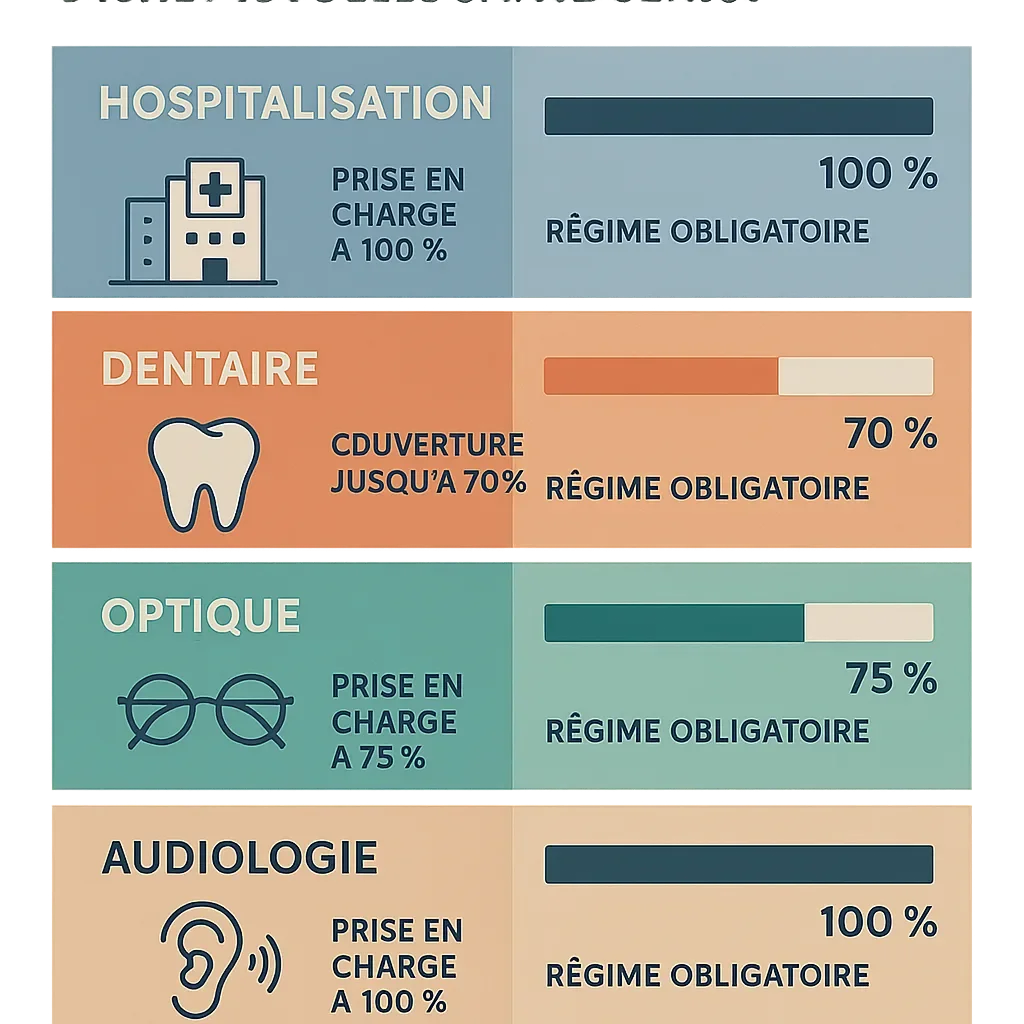
Next come the three areas that often make estimates wince: dental, optical, and audiology. It’s no coincidence that comparison sites always put them at the top. A crown, progressive glasses, or a hearing aid can quickly weigh heavily if the insurance only offers symbolic reimbursements.
To see clearly, here are the coverages to prioritize:
| Coverage | Why it matters | What to check |
|---|---|---|
| Hospitalization | Prevents the medical stay from becoming a financial abyss | Daily allowance, private room, excess fees, transport |
| Dental | Prostheses and implants are often poorly reimbursed | Annual ceiling, BRSS percentage, waiting period |
| Optical | Complex lenses and frames can be expensive | Frame, lenses, renewal frequency, care network |
| Audiology | Hearing aids remain a sensitive area after 60 years old | Reimbursement level, renewal, 100% Health basket |
| Assistance | Useful in case of return home or immobilization | Housekeeping, meal delivery, pet care, teleassistance |
In practice, a solid senior insurance does not promise “full reimbursement.” It absorbs major shocks, limits out-of-pocket expenses, and keeps clear ceilings. It’s a simple nuance, but it changes everything at the time of reimbursement.
From what age does a senior health insurance plan become useful?
There is no magical age set in stone. However, from 55-60 years old, many contracts become more interesting to seriously compare, because needs evolve: more frequent dental care, vision monitoring, hearing, and sometimes more regular hospitalization. The idea is not to panic, but to anticipate.
We can simplify the profiles as follows:
- 55-64 years old: priority to hospitalization, a good basic level in optics, and coverage that remains flexible if you are still active.
- 65-74 years old: pay attention to dental and audiology expenses, often more solicited, with truly useful limits.
- 75 years and older: assistance, private rooms, and home services become more valuable, as comfort and support count as much as straightforward reimbursement.
In other words, the right time to change is not always “at retirement,” but “when the group contract no longer fits your needs.” And that varies greatly depending on whether you rarely see a doctor or start multiplying ongoing care.
How to read a contract without being trapped by the introductory rate?
The classic trap is to look at the contribution before everything else. Yet the real cost depends on the combination of price + reimbursement level + limits + exclusions. A contract at €50 per month can be less interesting than another at €70 if it better covers care that really costs a lot.
Here are the points to check without cheating by skimming:
- The annual limit: beyond a certain amount, the insurance no longer follows. For dental and optics, this is often decisive.
- The waiting period: some guarantees do not start immediately. A bad surprise if you have care planned soon.
- Exclusions: prostheses, implants, excess fees, or services not covered can be quietly removed from the contract.
- Third-party payment: useful to avoid upfront costs, especially in pharmacy, optics, and sometimes hospitalization.
- The care network: it can reduce the bill at certain partner opticians, dentists, or audiologists.
According to ameli.fr, the 100% Health scheme applies to defined baskets in optics, dental, and audiology. It is useful, of course, but it is not a magic wand: as soon as you go outside the basket, the level of the insurance becomes central again.
Good to know: a formula that “covers everything” in appearance can actually cap very quickly. So you need to look at the general conditions, not just the commercial table. It’s not the most fun part of the contract, but it’s often where the real game hides.
What budget should be planned according to your profile?
The budget for a senior health insurance mainly depends on age, geographic area, level of coverage, and health status. In practice, the contributions observed on the market often increase with age, and the difference between an entry-level formula and a reinforced formula can be clear.
To get your bearings, it’s better to think in terms of needs rather than just price:
| Profile | Budget often sought | Useful level of coverage |
|---|---|---|
| Active senior 55-64 years old | Moderate | Hospitalization + decent optical + assistance |
| Retired 65-74 years old | Intermediate | Enhanced dental, audiology, and private room |
| 75 years and older | Higher but targeted | Assistance, care follow-up, and solid ceilings on major items |
The real issue is therefore not “how much I pay,” but “how much I risk paying out of pocket if I have a serious problem.” With equal coverage, a slightly more expensive contract can be much more cost-effective if you wear progressive glasses, have regular dental care, or have recently been hospitalized.
How to pay less without sacrificing coverage?
You can reduce the bill without compromising protection. The secret is to cut unnecessary options, adjust reimbursement levels to your actual needs, and check if you are eligible for assistance. A senior health insurance is not meant to be luxurious; it must be fair.
The right reflex is not to chase the lowest premium, but to look for the contract that avoids a big reimbursement gap at the wrong time.
Here are the levers that work best:
- Remove gadget options if you never use certain therapies or additional services.
- Compare ceilings before comparing prices, otherwise you are comparing apples and oranges.
- Check the couple plan if you have the same needs as your partner: sometimes, the price difference is interesting.
- Look at the care network to reduce out-of-pocket expenses for optical, dental, or audio care.
- Examine possible aid, especially the Complementary Health Solidarity if your income is modest.
There is also a frequently overlooked case: switching from company health insurance to an individual contract upon retirement. Here, you need to compare quickly because a premium that seemed reasonable while working can become much less attractive once the employer’s contribution disappears.
In other words, paying less is not incompatible with good coverage. But you must accept a simple rule: if the insurance is too “light,” it will save you 20 € per month but cost you 800 € the day you really need to use it. That’s why you must think in terms of useful protection, not commercial display.
FAQ — senior health insurance
Is senior health insurance mandatory?
No, it is not mandatory as such. However, it often becomes very useful as soon as health expenses increase or the company complementary insurance is no longer suitable. Without solid coverage, out-of-pocket costs can quickly rise for dental, optical, or hospitalization expenses.
Can you keep your company health insurance after retirement?
Yes, in some cases, but the premium often changes after retirement. The group contract can be kept, but it is sometimes less advantageous than expected once the employer’s contribution is removed. It’s better to compare before signing the continuation.
Is 100% Health enough to avoid taking enhanced insurance?
Not always. The scheme covers specific packages in optical, dental, and audiology, but as soon as you want equipment outside the package, higher fees, or better comfort at the hospital, the complementary contract becomes important again. 100% Health helps, it does not replace everything.
Are alternative medicines worth it in a senior insurance?
Only if you really use them. Otherwise, it is often an option that increases the premium without providing concrete value. For a senior who rarely consults this type of care, it is better to strengthen hospitalization or dental coverage, which weigh more heavily in case of trouble.
Is a couple plan always more interesting?
Not systematically. If both people have similar needs, the couple offer can be relevant. But if one mainly needs optical and the other audiology, two separate contracts can sometimes be better calibrated. You need to compare the total cost, not just the “promo” label.
Can you get help to pay for health insurance?
Yes, depending on your income. The Complementary Health Solidarity can significantly reduce the bill for low-income households. Other assistance sometimes exists through certain pension funds or local schemes, but they are less visible. That is why it is better to check your eligibility before subscribing at random.