
In brief
🧾 Since January 1, 2016, private companies must offer collective health insurance to their employees, with a minimum employer contribution of 50%.
🛡️ The exemption from enrollment exists, but only in cases provided for by the implementation text: other mandatory coverage, short fixed-term contract, beneficiary of CSS, or similar situation.
🔁 In case of departure entitling to unemployment benefits, portability can extend coverage up to 12 months maximum, without additional contribution from you.
📌 The right reflex: check the collective agreement, the information notice, and the request date. In mandatory health insurance, details often make all the difference.
Is mandatory company health insurance imposed on all employees?
In principle, yes: in the private sector, mandatory company health insurance applies to all employees since January 1, 2016. The employer must offer a compliant collective contract and finance at least half of the contribution. But some legal exemptions exist, with supporting documents.
The starting point is the ANI (National Interprofessional Agreement) and its implementation since January 1, 2016. Since that date, every private company must implement collective health coverage for its employees, except for specific cases provided by regulations or by the founding act of the scheme.
Concretely, this means that an employee hired in Nantes, in Lyon or Lille does not have complete freedom to choose an individual plan if they fall under the collective contract. However, they can request an exemption if the situation corresponds to a legal reason. The law is not “à la carte,” but it is not without relief either.
To check the general framework, you can consult the Service-Public.fr fact sheet on collective health insurance. It is often the best entry point to understand what the employer must offer, and what exceptions the employee can invoke.
What are the exemption cases to know before signing?
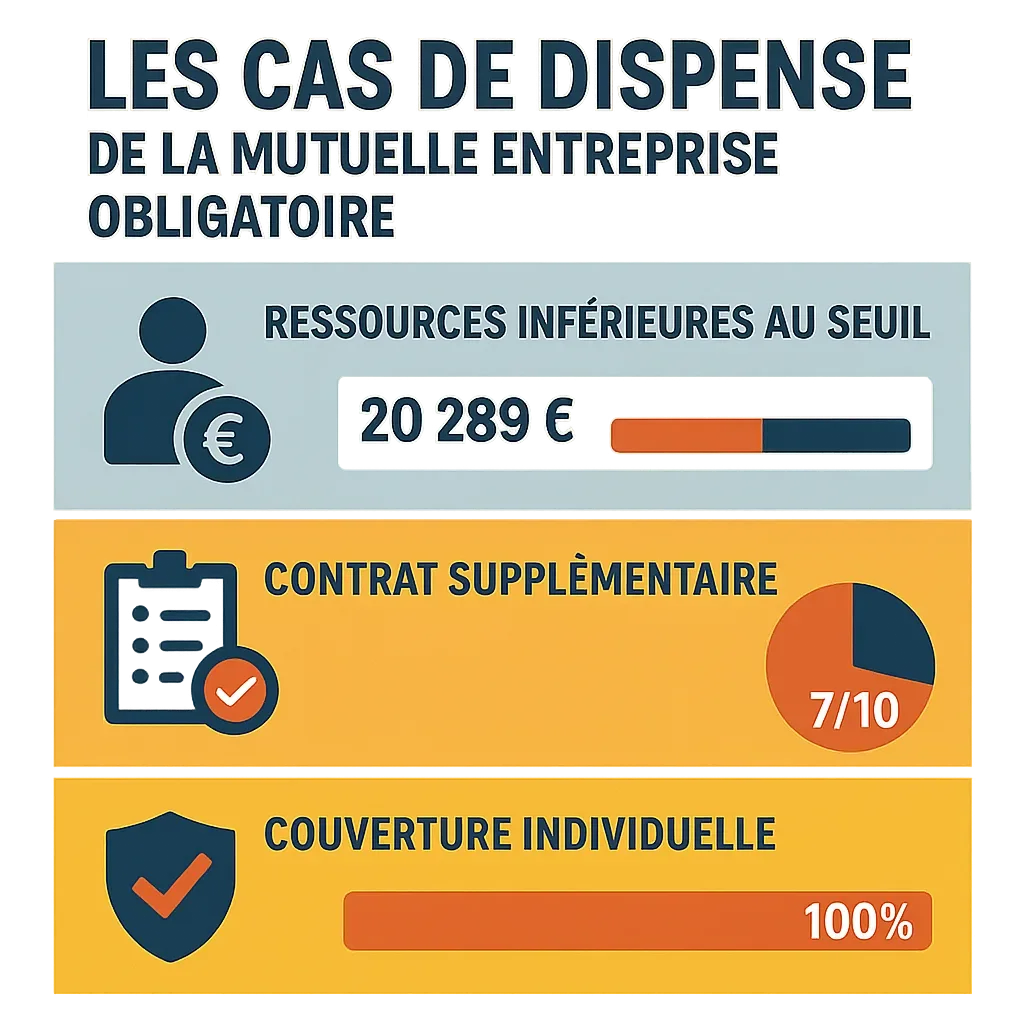
Yes, but not on a whim. Exemption cases must be provided for by the company’s collective agreement, then requested in writing. They mainly concern employees already covered elsewhere, certain fixed-term contracts or apprentices, and CSS beneficiaries. Without proof, the request can be refused.
Exemptions from enrollment are one of the most misunderstood points. Many employees think that a simple “I don’t want to” is enough. In reality, that’s not how it works at all. A legal reason, a written request, and almost always an up-to-date supporting document are required.
| Situation | Possible exemption? | Required document |
|---|---|---|
| Already covered by another mandatory supplementary insurance | Yes, if the collective agreement provides for it | Coverage certificate |
| Fixed-term contract or short assignment | Often yes, depending on the collective contract | Written request + employment contract |
| Part-time or apprenticeship | Possible in certain specific cases | Request dated + supporting documents |
| Beneficiary of the CSS | Yes, in principle | CSS certificate |
In practice, an HR manager of an SME in Lyon notices that exemption requests mostly arrive at the time of hiring, when the employee discovers that they are already paying for a family mutual insurance. Refusals rarely come from the principle itself; they mostly come from a missing supporting document or a form signed too late.
The detail to watch is the implementation act of the collective scheme: company agreement, employer’s unilateral decision, or referendum. It is this that sets the authorized exemption cases, the procedure to follow, and sometimes the frequency of renewal of supporting documents. In short, the paperwork matters as much as the reason.
How much must the employer pay and what does the minimum contract cover?
Minimum 50%: this is the contribution share that the employer must finance for the collective health insurance, in France, under the general framework resulting from the ANI.
Maximum 12 months: this is the portability duration after contract termination, if conditions are met.
The employer cannot settle for a cheap formula. The regulations require a minimum care package, often called the “mandatory base.” It notably covers a significant part of routine expenses, the daily hospital fee, and a minimum level in dental and optical care. In other words, the contract must be real, not just decorative.
The 50% rule is important because it prevents the supplementary insurance from relying entirely on the employee. If the company chooses a more protective formula, it can of course go beyond this minimum. Cherry on top, some collective agreements provide more generous guarantees than the legal framework, which can change the game depending on your sector.
Conversely, if you see a deduction on your payslip that seems excessive, first check if an optional top-up insurance has been subscribed. This one generally is not included in the mandatory base and may be financed differently. The classic trap is to confuse the legal minimum with an additional option.
For practical additional information, the explanations on ameli.fr about collective health insurance help better distinguish the minimum package, additional guarantees, and cases where you can compare several levels of coverage.
What happens if you change jobs or leave the company?
In case of departure giving entitlement to unemployment benefits, portability allows you to keep health coverage without paying more, during the duration of the last contract and up to 12 months. If you join a new employer, the new mutual insurance takes over, sometimes with a short transition period.
Leaving the company does not necessarily mean an immediate break in coverage. If you meet the conditions, portability extends rights free of charge for the former employee, provided they were covered before the contract termination. The mechanism is simple on paper, but you must carefully check the dates, otherwise you end up with a coverage gap.
This rule is particularly useful when the unemployment period drags on a bit. To put it bluntly: between two contracts, it’s better to know where you are covered rather than discover afterward that reimbursements are blocked. A family who arrived in 2022 in a town in the West actually reported discovering portability too late, after a dental treatment remained partially at their expense.
Be careful also when changing employers. If you sign elsewhere, the new company health insurance generally applies according to the terms of the new employer’s collective contract. Depending on the situation, you can request a transitional exemption if you are already covered elsewhere, but again, everything depends on the company policy and the supporting documents submitted at the right time.
What to do if the mandatory health insurance is not applied correctly?
Start by checking the implementation document, your employment contract, and the information leaflet given at hiring. If an employee should be covered but is not, or if a legal exemption was refused without a valid reason, you must request a written correction from HR, the payroll department, or the Works Council, with supporting documents.
The best approach is to go from the simplest to the most solid: written follow-up, copies of supporting documents, reminder of the applicable rule, then escalation if necessary. In practice, errors often come from a missing document or an incomplete form, not from outright bad faith. But when there is a blockage, it must be dealt with quickly. Deductions and reimbursements do not wait patiently in a corner.
If dialogue stalls, rely on clear institutional sources: Service-Public.fr for the general rule, and ameli.fr for coverage principles. The goal is not to “build a case,” but to show in black and white whether the situation is compliant or not.
The real question is not “can I avoid paying?”, but “does the collective contract allow me a clean, documented, and defensible exit?”. In company health insurance, this is often where everything is decided.
How to check your rights without wasting time?
The most effective method is to cross-check three documents: the information leaflet of the health insurance, the implementation text in the company, and your current coverage proof if you are requesting an exemption. This trio is often enough to know if you are obliged to join, exempted, or in a gray area.
Then, ask yourself three simple questions. Am I in a case of exemption provided by the company? Do I have written and dated proof? Was the request made at the right time, that is, at hiring or as soon as the reason exists? If even one answer is shaky, the file deserves to be reviewed before validating it.
One last useful reflex: look at the payslip and the contract’s effective date. Many employees discover the health insurance when the first deduction is made. At that point, it is sometimes too late to claim an exemption without going through a more formal exchange with HR. It’s better to be clear from the start; it avoids headaches.
- Before signing: read the leaflet and the collective scheme.
- At hiring: check if an exemption applies.
- In case of change: submit a new certificate if necessary.
FAQ: your frequent questions about mandatory health insurance
Can you keep your spouse’s health insurance in addition to the company health insurance?
Yes, but this does not automatically cancel membership in the collective contract. If the spouse’s coverage is mandatory and the company’s document provides for this case, you can sometimes request an exemption. Otherwise, you can remain covered at two levels, but it costs more.
Does portability work after resignation?
Generally, portability assumes a termination that opens rights to unemployment insurance. A “classic” resignation therefore does not open the same rights as a dismissal or the end of a fixed-term contract. You must check the exact reason for leaving and the situation with France Travail before counting on it.
Is an apprentice automatically exempt?
No, not automatically. The apprentice can benefit from an exemption in certain cases provided by the company, notably depending on the cost of the contribution, the nature of the contract, and internal rules. The key word, once again, is the collective text, not the idea one has of the rule.
Is it necessary to reapply for an exemption every year?
Often yes, especially if the company requires periodic proof. Many plans require renewed evidence to verify that the reason still exists. If your other coverage expires or changes, the exemption may lapse on its own. It’s best to set a reminder in your calendar.
Can the employer require coverage higher than the legal minimum?
Yes, of course. The legal minimum sets a baseline, not a ceiling. A company can offer a more generous contract, for example with better reimbursements for vision or dental care. However, it must still comply with the exemption rules and the minimum portion funded by the employer.
What should I do if I forgot to request the exemption on time?
You need to act quickly and in writing. Notify HR, attach your proof, and ask if a correction is still possible. Depending on the collective plan, late requests may be refused. The longer you wait, the greater the risk of having to wait until the next renewal deadline.