
In brief
💡 The mutual third-party payment avoids having to advance all or part of the healthcare costs: the Health Insurance pays its share, then the complementary insurance takes its share if the care is covered.
🧾 In the partial version, you may still pay deductibles, a fixed contribution, or excess fees. In the full version, the advance payment is much more reduced.
📍 The system works especially well when the Vitale card is up to date, the mutual insurance certificate is valid, and the professional practices third-party payment.
⚠️ In case of blockage, the problem often comes from a silly but fatal detail: mutual insurance not electronically transmitted, expired card, or care outside the agreement. Joking aside, this is often where everything is decided.
How does the mutual third-party payment work?
The mutual third-party payment eliminates the advance payment on the portion reimbursed by Health Insurance and, depending on the contract, on the complementary part. Concretely, the healthcare professional is paid directly by the CPAM and/or the mutual insurance, which saves you from having to use your credit card at the time of care.
The mutual third-party payment avoids advancing the part reimbursed by Health Insurance and, sometimes, that of the complementary insurance. The healthcare professional is paid directly, provided the Vitale card and mutual insurance certificate are valid. Otherwise, the patient pays upfront.
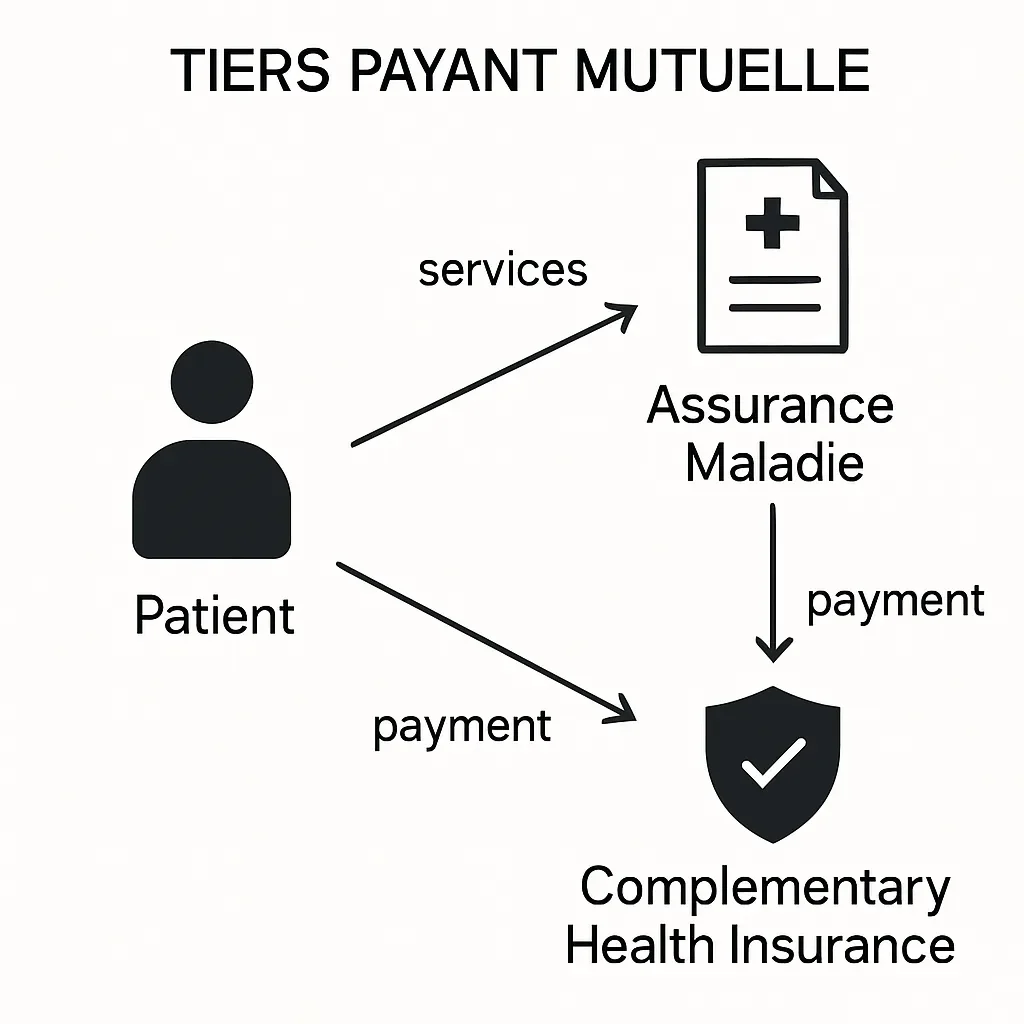
The usual process is quite mechanical: you present your Vitale card, sometimes accompanied by your mutual insurance card or your rights certificate. The professional then sends the care invoice to Health Insurance, then, if the complementary insurance is connected, to your mutual insurance. This is called electronic transmission.
This organization works well because it separates roles. The CPAM covers the mandatory part, the mutual insurance covers all or part of the complement, and you only pay what remains. The official rules are detailed on the ameli page on third-party payment and on the dedicated Service-Public sheet.
In other words, third-party payment does not change the theoretical reimbursement amount, it mainly changes when you pay. That is the whole difference: if the care is covered and the file passes correctly, you no longer need to wait a few days later for a reimbursement to get your money back.
What is the difference between partial third-party payment and full third-party payment?
Partial third-party payment only removes part of the advance payment, whereas full third-party payment can erase almost the entire amount to be paid immediately. In practice, the difference depends on what is covered by Health Insurance, by the mutual insurance, and what remains outside the scope: deductibles, excess fees, or non-reimbursed acts.
| Formula | What you advance | Common cases | Limit |
|---|---|---|---|
| Partial third-party payment | Part of the care, often the co-payment or the supplement | Consultation, pharmacy, routine exams | Out-of-pocket expenses may remain |
| Total third-party payment | Nothing, or almost nothing on covered care | Certain health centers, CSS, maternity, hospitalization depending on contract | Non-covered acts remain payable |
The key point is the co-payment: it corresponds to the portion remaining after the basic reimbursement from Health Insurance. If your mutual insurance covers this co-payment, third-party payment becomes much more comfortable. But beware, extra fees from sector 2 are not automatically covered, even with good supplementary insurance.
With a specialist or in certain clinics, the professional may accept third-party payment on the mandatory portion but ask you to pay the difference on site. This is not an anomaly: it simply shows that the mutual insurance contract and the practitioner’s mode of practice do not necessarily cover the same things. That is why you should always check the estimate when amounts start to rise.
What is the out-of-pocket cost after third-party payment?
After a mutual third-party payment, there may remain amounts to pay that neither Health Insurance nor the supplementary insurance really reimburse. This notably includes certain medical deductibles, the fixed contribution, extra fees, and care not included in the reimbursement basket. In short: third-party payment does not erase everything, it mainly limits the advance payment.
Third-party payment is useful when it truly simplifies life. If it becomes opaque or blocked, it loses its original promise: to save you from advancing money at the wrong time.
To visualize, imagine a regulated consultation: Health Insurance reimburses part of the base rate, the mutual insurance can complement, but the fixed contribution of €2 often remains due for a medical act in adults, unless exempted. Sometimes extra fees are added if the practitioner charges above the regulated rate.
The case of glasses, dental prostheses, or hearing aids is somewhat different. With 100% Health, some equipment can be offered with no out-of-pocket cost if you choose the offer from the relevant basket. Otherwise, the estimate can quickly rise, making it really essential to read the mutual insurance coverage carefully.
| Care | What the mandatory portion covers | What the mutual insurance often covers | Possible remaining cost |
|---|---|---|---|
| Consultation with a regulated doctor | Part of the base rate | Co-payment depending on contract | €1 + possible extra fees |
| Reimbursable medicines | Reimbursement according to applicable rate | Possible supplement | €0.50 deductible per box |
| Hospitalization | Acts and stay according to coverage | Sometimes daily flat rate | €20/day flat rate if not covered |
| Optics / dental / audio | Often low base | Flat rate or 100% Health basket | Significant gap if outside basket |
In which cases is third-party payment by mutual insurance automatic or mandatory?
The third-party payment by mutual insurance is not reserved for “comfort” cases. In several situations, it becomes automatic or widely offered: Complementary Health Solidarity (CSS), AME, certain care related to pregnancy, to long-term illness (ALD), to a work accident or to an occupational disease. Some preventive acts also grant access to it.
According to the rules recalled by Service-Public and ameli, third-party payment can be mandatory on the covered portion in certain specific cases, but it does not apply identically everywhere. This is where nuances matter: a health center, a pharmacy, and a private practice do not always have the same practices.
Moreover, the professional’s contractual agreement plays a huge role. A sector 1 doctor will generally have a simpler understanding of the system than a sector 2 specialist with free fees. It’s not just a matter of goodwill: it is also a question of billing, software, and contractual rules between the practitioner and the paying organizations.
What to do if third-party payment by mutual insurance does not go through?
When third-party payment by mutual insurance does not go through, you should start by checking the basics: up-to-date Vitale card, valid mutual insurance certificate, active teletransmission, and care properly covered. The most frequent failure is not “administrative” in the noble sense of the term: it often comes from an expired document, a poorly synchronized contract, or a care outside coverage.
In case of refusal, start by checking the update of the Vitale card, the validity of the certificate, and the teletransmission mode. If the problem persists, request a quote or an invoice to be reimbursed later by your mutual insurance.
Here is the simplest method, without manually going through a difficult process:
- Check the Vitale card at a terminal in a pharmacy, CPAM cash desk, or with some equipped professionals.
- Check the mutual insurance certificate: name, contract number, validity date, beneficiaries.
- Ask if the practitioner applies third-party payment on the mandatory part, on the complementary part, or on both.
- Request a quote if the care is expensive, especially in dental, optical, or audiology.
- Keep the paid invoice for secondary reimbursement if the mutual insurance must intervene afterward.
The golden rule is not to confuse refusal of third-party payment with lack of reimbursement. The professional can very well refuse direct advance payment while still allowing your file to be reimbursed later. Conversely, uncovered care will remain your responsibility, even if the invoice has been processed. To top it off, the two cases sometimes look similar from afar, but not at all on the bank statement.
FAQ — Third-party payment by mutual insurance
Does third-party payment by mutual insurance work with all doctors?
No, and this is where many get caught out. Third-party payment can be offered, partial or total, but it is not applied the same way with all practitioners, especially in sector 2. Health centers, pharmacies, and some laboratories use it more than private practices.
Can you have third-party payment without a Vitale card?
Yes, but it is less smooth. The professional can sometimes take a rights certificate or a mutual insurance card, but the Vitale card remains the easiest way to trigger teletransmission. Without it, the patient risks having to advance fees more often.
Does mutual insurance reimburse fee overruns?
Sometimes, but not automatically. It depends on the contract: some packages are very generous, others limited to a percentage of the base rate. The practitioner’s quote remains essential as soon as a specialist announces fees above the agreed tariff.
Does third-party payment work at the hospital?
Yes, but not always in the same way depending on the stay, the type of facility, and the supplementary coverage. The daily fee, for example, may still need to be paid if the mutual insurance does not cover it. For a scheduled hospitalization, the estimate or coverage simulation prevents unpleasant surprises.
What should I do if my mutual insurance card has expired?
You need to request an up-to-date certificate from your supplementary insurer, then check that the teletransmission is properly reactivated. In most cases, a simple updated document is enough to get the file back on track. If the care is urgent, keep the receipts for later reimbursement.
Does mutual insurance third-party payment also cover optical and dental care?
Yes, but with significant differences depending on the contracts and the chosen equipment. In optics and dental care, the bill largely depends on the selected package and the coverage limits. The 100% Health offers are precisely there to limit out-of-pocket expenses on certain equipment.